Search This Blog

Tuesday, November 27, 2018

U.S. Route 2

U.S. Route 2 (in red)
U.S. Route 2 is the northernmost U.S. highway, running 2,000 miles from Everett WA to St. Ignace MI, and another 460 miles from Rouses Point NY to Houlton ME. The two segments are connected by roads in Canada.

In 1925, the American Association of State Highway Officials set up a numbering system for U.S. highways. The numbers of the major transcontinental east-west highways went up, north to south, from Route 2 to 10, 20, 30, and so on, up to Route 90, which ran from Florida to Texas. (Route 2 was the lowest number, because they didn't want to use zero.)
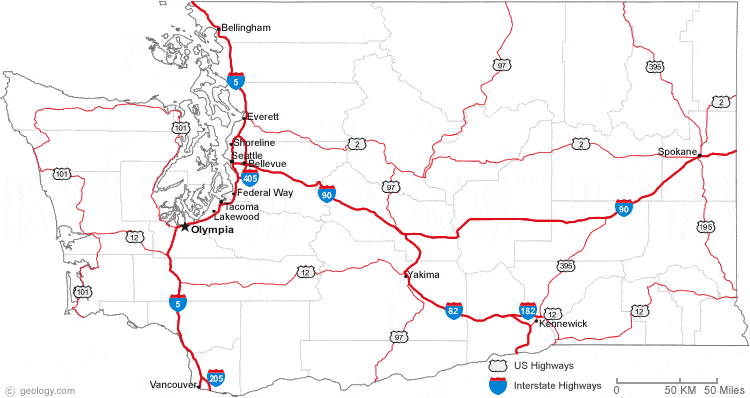
Washington highways and interstates
The 1925 north-south highways were numbered 1 (Maine to Florida), 11, 21, 31, and so on, all the way to 101 from Port Angeles WA to San Diego. 

With the construction of the Interstate Highway System in the 1960s and later, many of the original 1925 U.S. numbers were replaced, in all or in part, by Interstate numbers. 

Monday, November 26, 2018

John F. Stevens


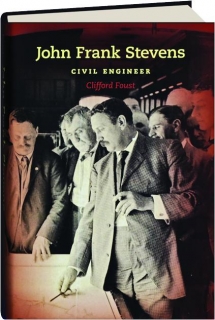
John F. Stevens (1853-1943), born in Maine, became a civil engineer in Minnesota and eventually was chief engineer and general manager of James J. Hill's Great Northern Railway. After mapping Marias Pass over the Continental Divide in Montana, he found the 4,061-foot pass through the northern Cascades that the Great Northern would take - and that would be named Stevens Pass, in his honor.  

The First Cascade Tunnel

The original route, in 1893, went over Stevens Pass, with many switchbacks. In 1900, the railroad replaced that route with the 2.3-mile Cascade Tunnel, under the pass. A second Cascade Tunnel, 7.8 miles long, replaced the first one in 1929, and is still used today. U.S. Route 2 now goes over Stevens Pass.

John F. Stevens left the Great Northern in 1903. In 1905, he was hired by President Theodore Roosevelt as chief engineer on the Panama Canal. He later worked on the Trans-Siberian Railway.


James J. Hill

James J. Hill (1838-1916) was born in Canada, but moved to St. Paul at the age of 18. He was successful in the businesses of coal, steamboats, and banking, but became best known as the "Empire Builder" with his Great Northern Railway and its line from St. Paul to Seattle, completed in 1893.

Hill statue at University  of Washington
 A key to the success of the transcontinental line was the discovery of the previously unmapped Marias Pass (5,213 feet) over the Continental Divide, just south of present-day Glacier National Park. The pass had been described by Lewis and Clark, but was not mapped until John F. Stevens, engineer with the Great Northern, did it in 1889 with the assistance of a Flathead Indian guide.


Saturday, November 24, 2018

Great Northern Railway

The Great Northern Railway, the northernmost transcontinental railroad in the U.S., went from St. Paul to Seattle via Fargo, Minot, Havre, Kalispell (later through Whitefish), Spokane, Wenatchee, and Everett, starting in 1893.


The Northern Pacific Railway paralleled the Great Northern (more or less), farther south. It ran from St. Paul to Tacoma, starting in 1883, via Fargo, Bismarck, Billings, Butte, Spokane, Pasco, and Yakima.

 The Great Northern, Northern Pacific, and two other lines merged in 1970 to form the Burlington Northern Railroad, which in 1996 became part of the BNSF Railway. Today, Amtrak's "Empire Builder" train goes from Chicago to Seattle, mainly on the Great Northern route - while much of the Northern Pacific route was abandoned by passenger service.

The "Empire Builder" was originally a Great Northern train, starting in 1929, honoring James J. Hill (1838-1916), the railroad's founder.

Thursday, November 22, 2018

Thomas Burke


Thomas Burke (1849-1925) was born in New York, arriving in Seattle at age 25. He was a lawyer and judge - serving as chief justice of the Supreme  Court of Washington Territory from 1888 to 1889 - and a founder of the Seattle, Lake Shore, and Eastern Railway. Today, his name is on the Burke-Gilman Trail and the Burke Museum.

Burke became the local attorney for the Great Northern Railway (based in Minnesota) and was instrumental in having its transcontinental line reach Seattle.

The Burke Museum was not always named for Burke. It was started in 1885, in downtown Seattle, as the Hall of the Young Naturalists, and was soon renamed the Washington State Museum. The museum moved into its building on 45th Street at the University of Washington in 1962, when it was renamed the Burke Museum, in recognition of a bequest honoring Thomas Burke.

Saturday, November 17, 2018

Daniel Gilman


Daniel Gilman (1845-1913) was born in Maine, a Civil War veteran and Columbia-educated lawyer. He moved in 1883 to Seattle, where his business interests included railroads, newspapers, and mining.

He established the Seattle Coal and Iron Co. in the town of Squak, which was incorporated in 1892 as the town of Gilman. Its name was changed to Issaquah in 1899. Today, Issaquah has Gilman Boulevard and Gilman Village - a shopping area made up of renovated historic buildings.

In Seattle, Gilman's name (along with that of Thomas Burke) is on the Burke-Gilman trail.

Seattle, Lake Shore and Eastern Railway

The Seattle, Lake Shore and Eastern Railway built about 300 miles of rail lines around the state of Washington during the years of its existence from 1885 to 1896, including the section in the Seattle area that became the Burke-Gilman Trail. The railway had lines on both sides of the Cascades, but never succeeded in crossing them.


Founded by a group of investors led by Thomas Burke and Daniel Gilman, the railway was taken over in 1896 by the Northern Pacific Railway, which had a transcontinental route from St. Paul to Tacoma. The Northern Pacific merged in 1970 with three other railroads to form the Burlington Northern, which in 1996 bought the Atchison, Topeka and Santa Fe Railway and became the BNSF Railway. 

Thursday, November 15, 2018

Burke-Gilman Trail

The trail, east of University Village
The 27-mile Burke-Gilman Trail runs from the Ballard neighborhood of Seattle, east past the University of Washington, then north and east along Lake Washington as far as Bothell, where it connects with the 11-mile Sammamish River Trail.

 
The trail runs on the former route of the Seattle, Lake Shore and Eastern Railway, founded in the 1880s by Thomas Burke and Daniel Gilman. The rail line was abandoned in 1971, and the first 12 miles of the trail opened in 1978.